

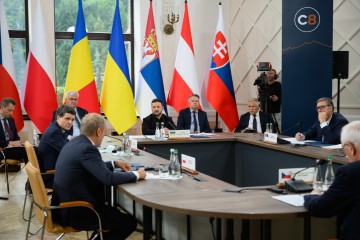
We, the Heads of State and Government and representatives of the Republic of Austria, the Republic of Poland, Romania, the Republic of Serbia, the Slovak Republic and Ukraine, participants of the Carpathian Integration Initiative Summit,
relying on the purposes and principles of the Charter of the United Nations, as well as the objectives and principles of the European Union’s Treaties, in particular the Cohesion Policy;
emphasising our commitment to deepening cooperation at all levels to ensure long-term security and stability in Europe, in particular by supporting stability, strengthening democratic resilience, good governance and the rule of law, including the respect of all human rights, and encouraging recovery and sustainable development in the Carpathian region;
emphasising that the security, stability and development of the Carpathian region are an integral part of the security, resilience and prosperity of the European community;
recognising the strategic importance of the Carpathian region as a unique geopolitical, economic, logistical and natural area within a united Europe, which links our countries and creates unique opportunities for the development of regional and cross-border cooperation;
building on the experience of many years of cooperation between the countries of the Carpathian Belt under the Framework Convention on the Protection and Sustainable Development of the Carpathians, the ‘Carpathians’ Euroregion, and within programmes for cross-border, transnational and interregional cooperation, in particular the European Union’s Interreg and Interreg NEXT programmes and other regional cooperation formats such as the Three Seas Initiative;
defining the Carpathian region as a cohesive European region – a single geographical area encompassing the territories of several countries linked by common economic and social realities, particular environmental vulnerability, ethno-cultural diversity, a rich tangible and intangible cultural heritage in need of preservation, restoration and joint promotion; and intertwined challenges requiring coordinated cross-border solutions at a pan-European level;
having regard to the Conclusions of the Council of the European Union on the implementation of macro-regional strategies, which recognise the valuable role of the Strategies in enhancing cooperation, trust, preparedness and resilience particularly in the face of current geopolitical and environmental challenges, as well as their contribution to the enlargement policy, by helping candidate countries to prepare their accession and align with key EU policies;
taking into account the experience of the successful implementation of the European Union’s macro-regional strategies for the Baltic, Danube, Adriatic-Ionian and Alpine regions and their contribution to strengthening territorial cohesion, economic development and cross-border cooperation;
bearing in mind the need to ensure complementarity with the EU Strategy for the Danube region which covers almost the entire Carpathian Mountains and includes a specific dimension for cooperation dedicated to the mountain area;
acknowledging that the Carpathian macro-region can benefit from the opportunities created by the common European policies, responding effectively to existing cross-border challenges, ensuring the resilience and sustainable development of communities and regions, and realising the vast economic potential of the countries in the Carpathian Belt,
We express our readiness:
to establish the Carpathian Integration Initiative as a platform for coordinating joint actions by states, their regions and local authorities, European Union institutions and other international partners, aimed at deepening European integration;
to ensure the functioning, within the framework of the Carpathian Integration Initiative, of a mechanism for cooperation between the states of the Carpathian region, European Union institutions and other interested partners at various levels, in particular through the annual holding of summits and other events under this Initiative;
to build upon, consolidate, and synergise with existing Carpathian mechanisms established by the active Interreg programmes, the Carpathian Euroregion, and the Carpathian Convention, as well as other complementary relevant regional cooperation formats, such as the EU Strategy for the Danube Region and the Three Seas Initiative;
to direct joint efforts within the framework of the Carpathian Integration Initiative towards strengthening good-neighbourly relations, cross-border cooperation, economic interconnectivity, security and sustainable development in the Carpathian region as part of the shared European area;
to promote the implementation of the Carpathian Integration Initiative as one of the tools supporting candidate countries in implementing the EU acquis and their participation in gradual integration;
to support the further practical development of the Carpathian Integration Initiative with a view to fully realising its significant potential in a pan-European dimension, and to consider the initiative of developing the European Union’s Macro-Regional Strategy for the Carpathian Region, which will build upon the EU Strategy for the Danube Region;
to support at various administrative levels initiatives and projects bringing together local and central authorities, civil society, youth and children’s organisations, business communities and the academic community in shaping the agenda of the Carpathian macro-region according to the ‘bottom-up’ principle,
to make active use of the European Union’s existing instruments for cross-border and regional cooperation, in particular the Interreg and Interreg NEXT programmes, in order to deepen the integration of the countries of the Carpathian region and implement joint cross-border and regional projects which support the development of Carpathian regions and local communities;
to support the conclusion by the regions participating in the Carpathian Integration Initiative of new interregional partnership and cooperation agreements, including by using the instrument of European Groupings of Territorial Cooperation (EGTC);
to enhance the energy resilience of the participating countries through the coordinated development of electricity, heating and gas infrastructure, considering the active introduction of distributed generation, renewable energy sources, energy efficiency and energy storage;
to facilitate the recovery and modernisation of critical infrastructure, based on the principles of resilience, security and adaptability to long-term threats, in particular by attracting investment to develop energy facilities, and to develop new generation capacity, energy storage facilities and grid infrastructure;
to ensure that the development objectives of the Carpathian macro-region are aligned with key EU initiatives in the field of sustainable development, paying particular attention to the implementation of the Framework Convention on the Protection and Sustainable Development of the Carpathians, by the protection of the Carpathians’ unique biodiversity, as well as the preservation of cultural landscapes, the traditional way of life of mountain communities and the associated elements of intangible cultural heritage, the circular economy, combating cross-border environmental pollution and managing climate risks, including the prevention of destructive floods;
to support the creation of a safe environment at local level by developing an effective civil protection system and enhancing the preparedness of local communities to respond to emergencies;
to facilitate the implementation of joint infrastructure projects aimed at integrating the transport and logistics infrastructure of the Carpathian region into the European transport network, modernising border infrastructure and developing modern transport corridors;
to promote tourism opportunities in the Carpathian region, the development of sustainable cultural tourism, the promotion of the natural, historical and cultural heritage of the Carpathian region, the development of shared cultural and tourist routes, and support for local cultural initiatives and traditional crafts;
to support the development of creative industries in the Carpathian region as a driver of economic resilience, employment and the preservation of local community identity;
to promote the exchange of experience and best practices amongst the countries of the region in the field of veterans’ policy and support for veterans, as well as to deepen cooperation at various levels with a view to facilitating the social, professional and civic reintegration of Ukrainian veterans.
We, the participants of the Summit, reaffirm the importance of enlargement as a major contribution to European peace, security, stability and prosperity. An efficient, merit-based and credible enlargement process must be sustained. The Carpathian Initiative can be a tool for supporting the gradual integration of candidates on their path to EU membership.
We will work to ensure the sustainable development and realisation of the economic potential of the Carpathian region, as well as to address existing and future common challenges in various areas of mutual interest.
We are convinced that the successful implementation of the Carpathian Integration Initiative will strengthen the stability and resilience of the countries in the region and become an important additional contribution to joint efforts to ensure lasting peace on the European continent.