

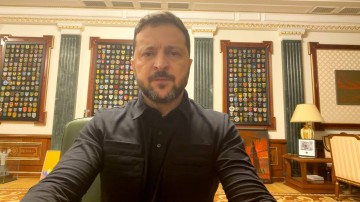
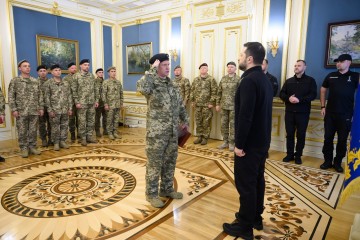
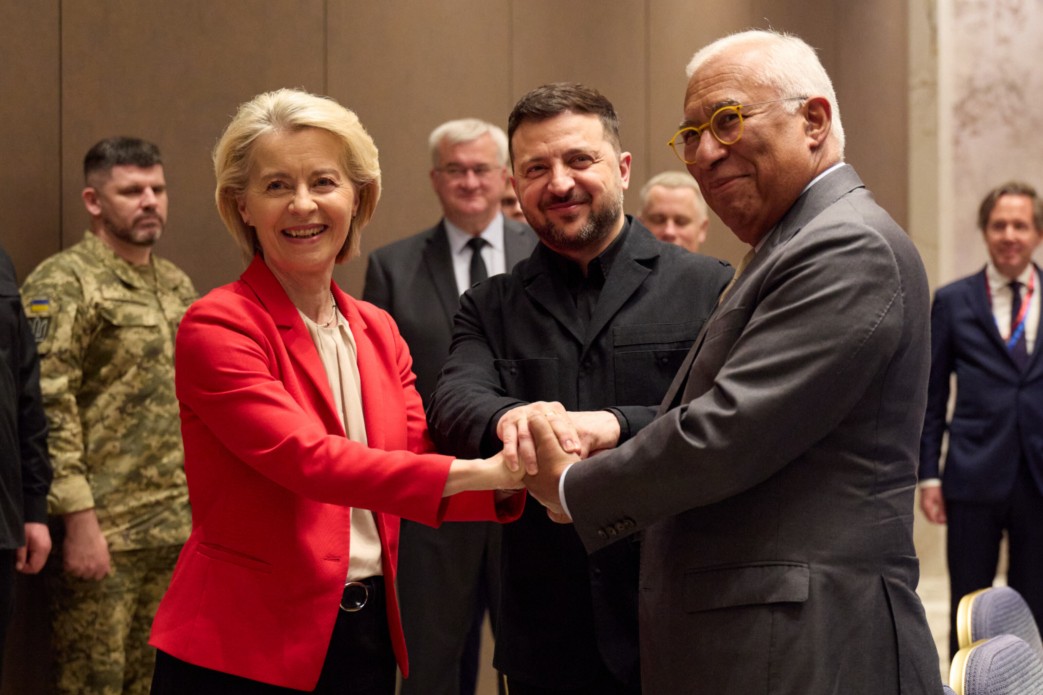
In April, the President of Ukraine’s diplomatic efforts focused on unlocking a EUR 90 billion financial assistance package for domestic weapons production and preparing the energy system for winter, strengthening cooperation with countries in the Middle East and the Caucasus – including ensuring diesel supplies for Ukrainian military and civilians – securing new contributions to the PURL initiative for the procurement of anti-ballistic missiles from the United States, and expanding cooperation with Europe to enhance the protection of lives and advance efforts toward building a European anti-ballistic defense system.
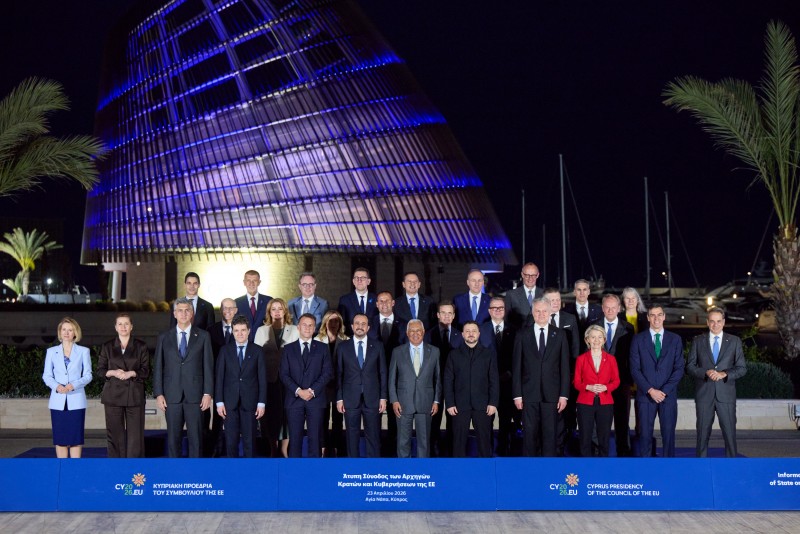
In April, Volodymyr Zelenskyy held 24 international meetings. Abroad, he met with President of Azerbaijan Ilham Aliyev, President of Italy Sergio Mattarella, President of Lithuania Gitanas Nausėda, President of Syria Ahmed al-Sharaa, President of Türkiye Recep Tayyip Erdoğan, King of the Netherlands Willem-Alexander, Federal Chancellor of Germany Friedrich Merz, Prime Minister of Denmark Mette Frederiksen, President of the Council of Ministers of Italy Giorgia Meloni, Prime Minister of the Netherlands Rob Jetten, Prime Minister of Norway Jonas Gahr Støre, President of the European Council António Costa, President of the European Commission Ursula von der Leyen, Crown Prince of Saudi Arabia Mohammed bin Salman Al Saud, Crown Prince of Norway Haakon, President of the Storting of Norway Masud Gharahkhani, Minister of Defense of Italy Guido Crosetto, and His All-Holiness Ecumenical Patriarch Bartholomew.
In Ukraine, the Head of State met with King of Sweden Carl XVI Gustaf, President of Moldova Maia Sandu, Director General of the International Atomic Energy Agency Rafael Grossi, President of the European Bank for Reconstruction and Development Odile Renaud-Basso, Minister for Foreign Affairs, Trade and Defense of Ireland Helen McEntee, and Minister of Defense of Spain Margarita Robles.
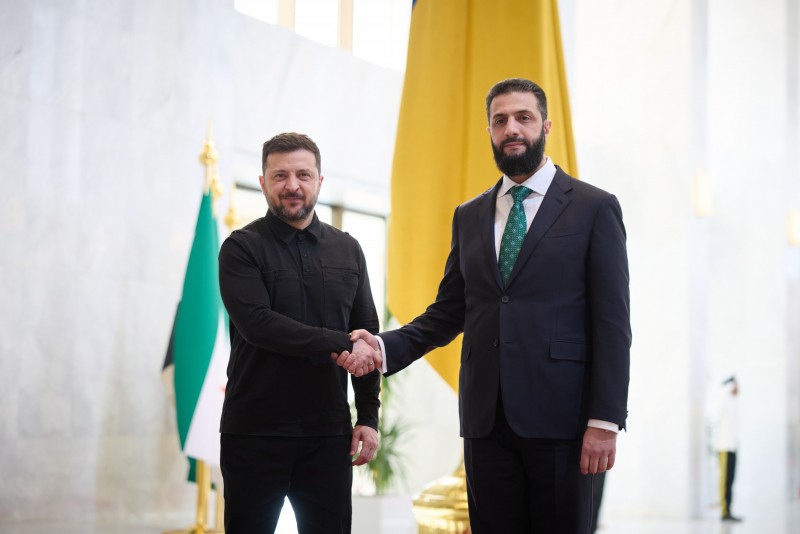
In April, Volodymyr Zelenskyy carried out nine visits: to Türkiye, Syria, Germany, Norway, Italy, the Netherlands, Cyprus, Saudi Arabia, and Azerbaijan.
In Istanbul, the President of Ukraine and the President of Türkiye agreed on new steps in security cooperation and discussed practical measures to implement joint projects in developing gas infrastructure, as well as opportunities for the joint development of gas fields.
In Damascus, during the first official visit by the President of Ukraine to Syria, Volodymyr Zelenskyy and Ahmed al-Sharaa agreed to work together to provide greater security and development opportunities for the societies of both countries.
In Berlin, the President of Ukraine and the Federal Chancellor of Germany agreed on preparing a Drone Deal, strengthening Ukraine’s air defense, expanding defense cooperation, providing additional support for Ukrainian drone production, contributing to the PURL initiative, and supporting the energy sector and reconstruction efforts.
At various levels, 10 documents were signed, along with six more between Ukrainian and German defense companies.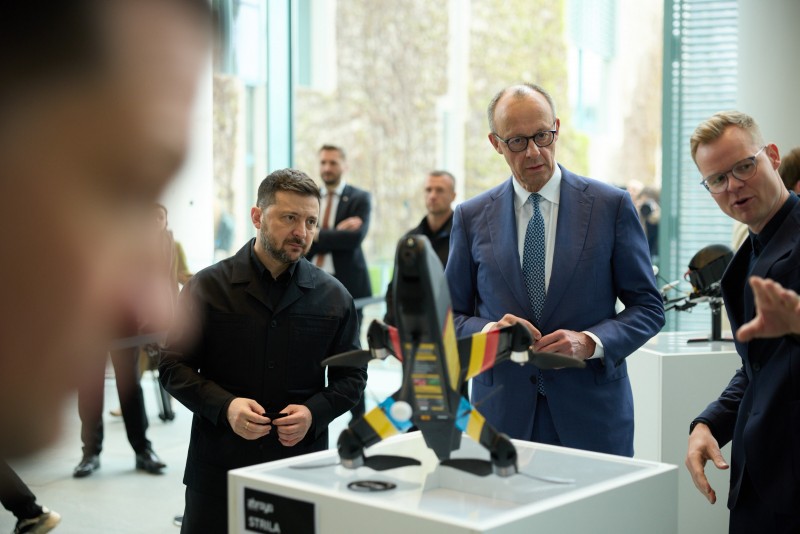
Volodymyr Zelenskyy and Friedrich Merz also held intergovernmental consultations, which took place for the first time in over 20 years.
In Oslo, Volodymyr Zelenskyy and Jonas Gahr Støre took the first step toward a Drone Deal by signing the Joint Declaration on Enhanced Defense and Security Cooperation. The leaders also agreed on strengthening Ukraine’s air defense and Norway’s additional contribution to the PURL initiative.
In Rome, the President of Ukraine and the President of the Council of Ministers of Italy agreed that their teams would work out the details of a Drone Deal. They also discussed opportunities for joint production of air defense systems.
In Middelburg, the President of Ukraine and the Prime Minister of the Netherlands signed a Joint Declaration on the start of work on the Drone Deal; a document on joint production was also concluded. The leaders agreed to cooperate on protecting and developing Ukraine’s energy sector, including decentralized energy systems.
In Cyprus, decisions were made to unlock a €90 billion financial support package for Ukraine, and the EU’s 20th sanctions package against Russia was adopted. The President of the European Council and the President of the European Commission highly commended Ukraine’s significant progress on its path to EU accession and called for the immediate launch of cluster negotiations. An agreement was also reached with three countries on undisclosed contributions to the PURL initiative worth €350–400 million.
In Jeddah, the President of Ukraine and the Crown Prince of Saudi Arabia continued to advance agreements in the fields of security, energy, and infrastructure.
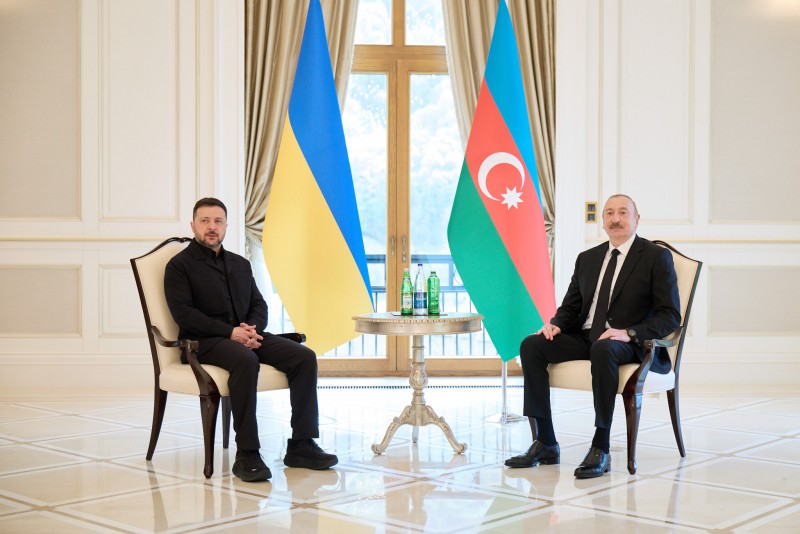
In Gabala, during the first visit of the Head of State to Azerbaijan since the start of Russia’s full-scale invasion, six bilateral documents were signed across various areas, including on cooperation in the defense industry.
In April, the Head of State also held 12 phone calls: with Pope Leo XIV, President of Egypt Abdel Fattah El-Sisi, President of Honduras Nasry Asfura, President of Finland Alexander Stubb, President of Chile José Antonio Kast Rist, Prime Minister of the United Kingdom Keir Starmer, Prime Minister of Norway Jonas Gahr Støre, Federal Chancellor of Germany Friedrich Merz, President of the European Council António Costa, President of the European Commission Ursula von der Leyen, NATO Secretary General Mark Rutte, and a video call with envoys of the President of the United States Steve Witkoff and Jared Kushner.
Participation in international events and meetings: the Four Freedoms Awards ceremony, a virtual meeting on Freedom of Navigation in the Strait of Hormuz, a meeting of EU Heads of State and Government, and the Chornobyl International Conference on Nuclear Safety and Recovery.
Other agreements and defense packages:
Belgium: EUR 75 million for the Czech initiative, EUR 75 million for the German air defense initiative, and EUR 85 million for the Drone Coalition.
The United Kingdom: the largest drone support package this year.
Estonia: USD 13 million for PURL.
Canada: USD 15 million to the NSATU fund, USD 42 million for the Czech initiative, and USD 17 million for critical engineering equipment.
Lithuania: EUR 39 million for the Czech initiative and EUR 29 million for the PURL initiative.
The Netherlands: EUR 248 million for Ukrainian drone production.
Germany: agreements on several hundred Patriot missiles, delivery of 36 IRIS-T launchers, EUR 300 million for long-range strike weapons produced in Ukraine, and the launch of joint production of mid-strike AI-enabled drones.
Norway: USD 560 million for basic drone supply for brigades and USD 150 million for a logistics hub.
The United States: a USD 100 million contribution announced for the repair of the damaged Chornobyl confinement structure.
Sanctions steps: Ukraine imposed sanctions on 23 more vessels of Russia’s shadow fleet, Russian entities supporting the enemy’s military-industrial complex, 121 Russian commanders, organizers and coordinators of missile strikes against Ukraine, individuals involved in the abduction of Ukrainian children, Russian religious and cultural propagandists, Belarusian companies supporting Russian aggression, and the inner circle of the self-proclaimed president of Belarus.