

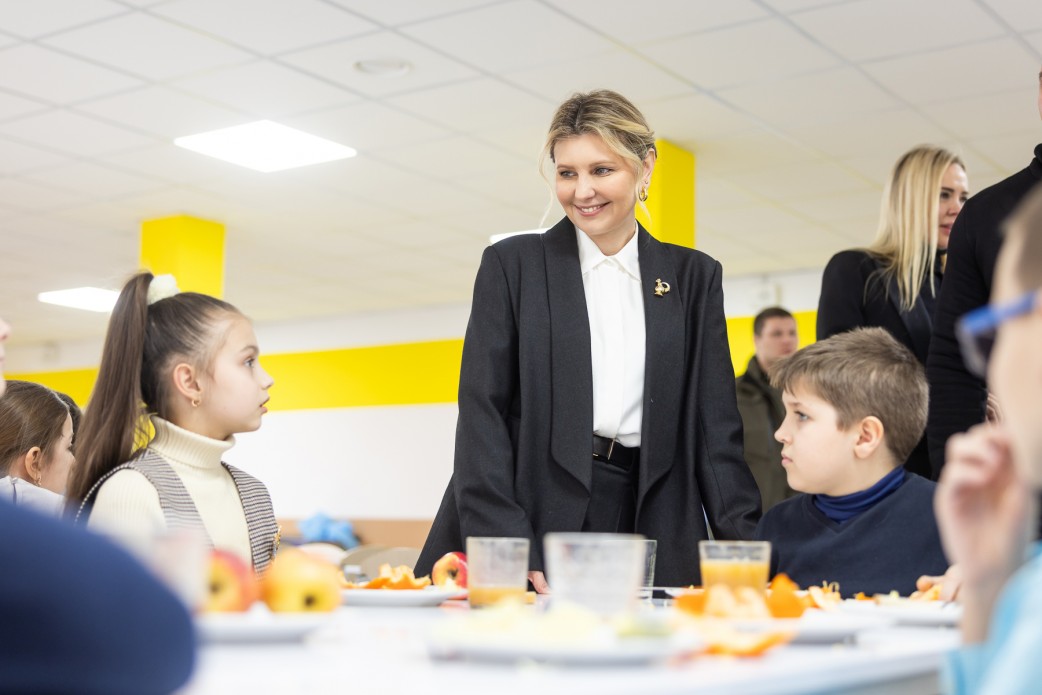
Since the beginning of 2025, more than two million children in Ukraine have been provided with free hot meals. This was announced by First Lady Olena Zelenska as she summed up this year’s results of implementing the school nutrition reform.
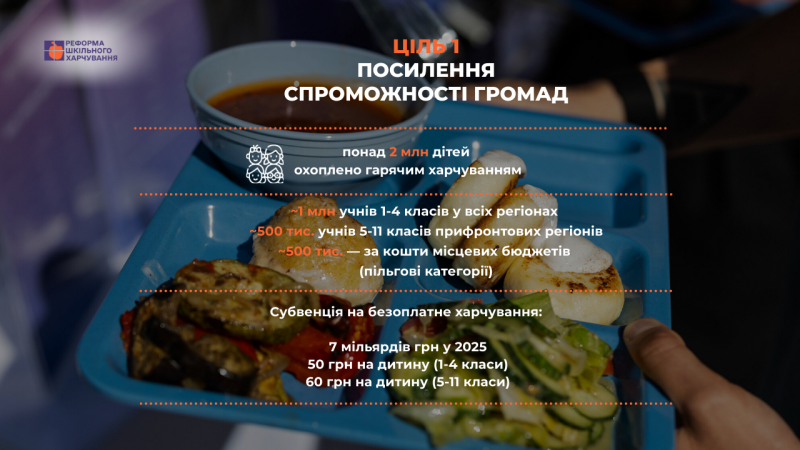 According to the President’s wife, one of the key achievements this year was the expansion of the free hot meals program. As of September 1, it has been available not only to primary school students across Ukraine, but also to students in grades 5–11 in frontline and border regions – namely, the Dnipro, Donetsk, Zaporizhzhia, Mykolaiv, Odesa, Sumy, Kharkiv, Kherson, and Chernihiv regions. To this end, the state allocated more than 7 billion hryvnias in subventions to local budgets in 2025.
“School lunches as a manifestation of care, as embodied equal opportunities regardless of whether a student lives in a large city or the smallest village, as free and high-quality support for entire families guaranteed by the state. During the defense of the country, all of this constitutes the strategic objectives of the school nutrition reform. I am glad that in 2025 they are being successfully fulfilled to bring maximum benefit to children and parents,” Olena Zelenska noted.
 This year, amendments were also introduced to the Cabinet of Ministers of Ukraine Resolution № 305 to regulate the organization of meals in shelters. This makes it possible to provide children with quality food even when the learning process is interrupted due to the threat of Russian strikes.
In addition, in 2025 an operational action plan was developed to implement the Strategy for Reforming the School Nutrition System in the coming years. The document sets out clear instruments for building an effective system of quality nutrition, promoting a culture of healthy eating, upgrading the material and technical base of educational institutions, supporting families with children, and stimulating local economic development.
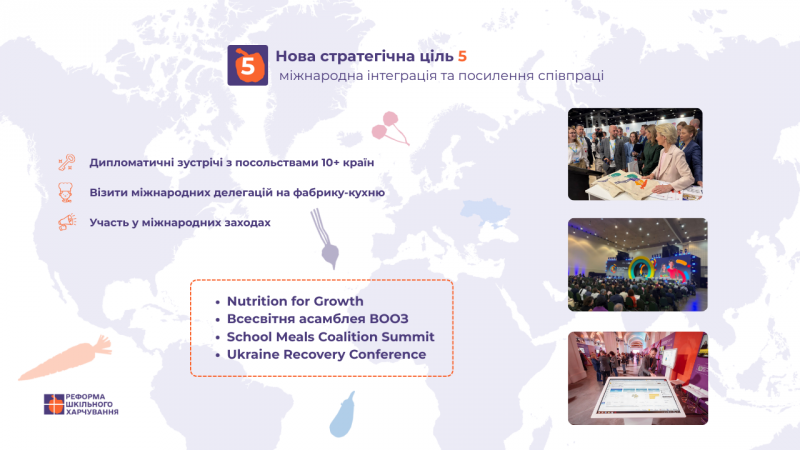 The school nutrition reform is increasingly being integrated into an international context. Accordingly, a fifth goal – developing international cooperation – was added to the Strategy, which will make it possible to scale up changes and enhance their effectiveness.
In parallel, the modernization of cafeterias has continued. This year, 75 new projects were implemented: 47 have been completed, and 28 are in the final stage.
The state budget for 2025 also allocated 960 million hryvnias in subventions for the modernization of kitchen facilities, including those in military and specialized lyceums. Following a competitive selection process, 79 projects were chosen and are to be completed by the end of the year.
To ensure transparency across all projects, technical support for the reform is provided by the European Union Anti-Сorruption Initiative (EUACI) in Ukraine. As part of a joint project with the Ministry of Education and Science of Ukraine and the reform team, an anti-corruption audit was conducted in 2025 for 355 school kitchen facilities modernization projects. This made it possible to prevent the unjustified expenditure of more than 320 million hryvnias and to ensure the effective and integrity-based use of public funds within the school nutrition reform.
A separate area of the reform is the development of the “kitchen factory” technological model, which provides for the centralized preparation of meals for educational institutions. The first kitchen factory began operating in December 2023 in Bucha with the support of The Howard G. Buffett Foundation. In 2025, a second facility was opened in the Kharkiv region, and five additional kitchen factory projects were selected, with implementation set to begin in the near future.
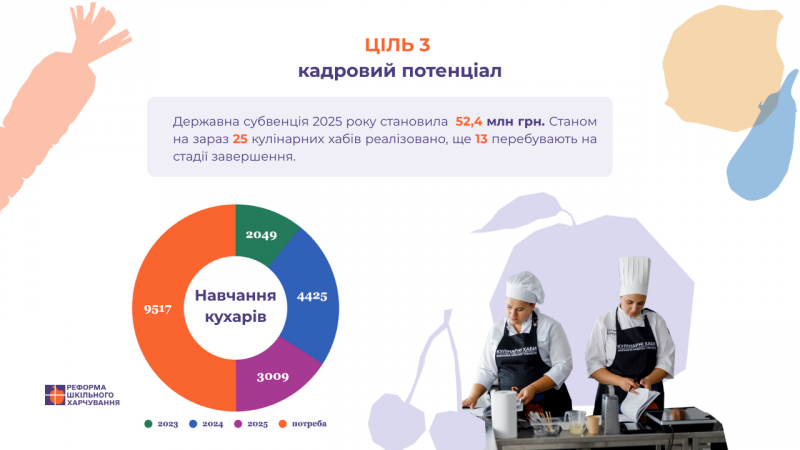
Throughout the year, work also continued on building a network of culinary hubs and training-and-practice centers based at vocational education institutions. The state allocated 52.4 million hryvnias for this area. In 2025, more than 3,000 school cafeteria cooks completed advanced training, bringing the total number of trained specialists over three years to 9,500.
 During the year, regions also hosted forums, trainings, and educational events, and free online courses and webinars were launched. In particular, the course “Fundamentals of Healthy Eating for Students in Grades 5–9,” created with the support of UNICEF in cooperation with the Ministry of Education and Science, the Ministry of Health, and the reform team, as well as webinars that brought together more than 5,000 participants. Informational materials for communities are regularly updated and are available on the Znaimo platform and on the project’s social media pages.
“We also do not forget the very first goal of the reform – the one from which it began back in 2021: all school lunches must be healthy and help shape a culture of healthy eating for an entire generation. Based on this year’s results, I believe that the state and communities have demonstrated their ability to keep going and work together for children every day, regardless of circumstances,” the President’s wife concluded.