



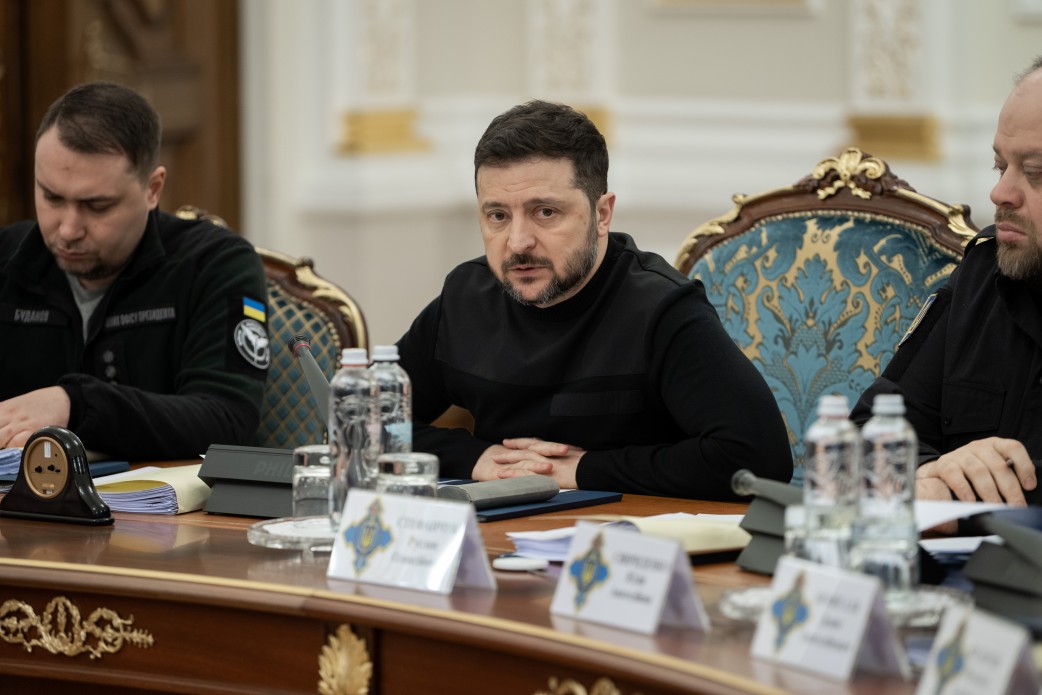
President of Ukraine Volodymyr Zelenskyy chaired a meeting of the National Security and Defense Council of Ukraine, during which comprehensive energy resilience plans for the country’s regions and cities were approved.
 The Head of State thanked the military, government officials, energy workers, rescuers, border guards, police officers, heads of regional military administrations, local authorities, and communities – everyone who helped, defended, set up assistance points and warming centers, and did everything possible to ensure people could survive.
According to Volodymyr Zelenskyy, the experience of this winter will serve as the foundation for further decisions: updating protection of infrastructure, logistics, and key energy facilities; restoring facilities damaged by Russian strikes; and ensuring additional energy sector capacity.
During the meeting, representatives of all regions and the largest cities delivered reports. The National Security and Defense Council approved resilience plans for every Ukrainian region and regional center except Kyiv. The capital was given additional time to prepare the relevant substantive documents.
“Kyiv was not ready today – just as it hadn’t been this past winter. For the next season, it is essential to get ready and complete every task. Every city and every Ukrainian community must be prepared for any scenario next winter and for providing real support to people. The Government of Ukraine, in particular the Ministry of Defense, and the Air Force of the Armed Forces of Ukraine have received the necessary tasks and will assist regions in preparing,” the President emphasized.
Secretary of the National Security and Defense Council Rustem Umerov noted that the regional resilience plans include clear instructions to the Cabinet of Ministers and the relevant ministries.
 “There must be a clear algorithm: who is responsible, within what timeframes, with what resources, and how implementation is monitored. The National Security and Defense Council ensures coordination at the state level – this means regular monitoring. The plans must work in practice. And our task is to ensure that no winter becomes an instrument of pressure against Ukraine,” Rustem Umerov said.
Prime Minister Yuliia Svyrydenko reported that the government will provide protection from UAVs and missiles for major facilities involved in electricity transit, gas extraction, and storage. Regions must ensure proper protection of substations, pumping stations, cogeneration facilities, block-modular boiler houses, and new facilities.
“It is important for us that every mayor, every regional head, and we as the government bear full personal responsibility for preparing regions and cities for the next heating season. And that we also bear responsibility for implementation, non-implementation, or untimely implementation,” Yuliia Svyrydenko stressed.
First Deputy Prime Minister – Minister of Energy Denys Shmyhal noted that the primary focus is on restoring main generation equipment destroyed by Russia, strengthening protection of critical infrastructure facilities, creating reserves of essential equipment, and building up gas reserves.
 “Active work is already underway in all these areas. Regarding equipment reserves, we are working with partners to secure a threefold reserve. As for distributed generation, the relevant tasks have been assigned to state-owned companies, local administrations, and communities. At the next energy ‘Ramstein’ meeting, we also plan to discuss attracting more than €5 billion to prepare Ukraine for the next heating season,” Denys Shmyhal said.
Deputy Prime Minister for Restoration of Ukraine – Minister for Communities and Territories Development Oleksii Kuleba noted that the plan approved by the National Security and Defense Council was developed together with local communities and is aimed at accelerating changes.
“The decision that has been adopted will be of enormous significance for many years to come. Today, the tasks are to do everything possible to ensure that settlements decentralize their water and heat supply systems and are as resilient and adaptable as possible to enemy attacks,” Oleksii Kuleba concluded.